Why Is the Game Called Zebra?
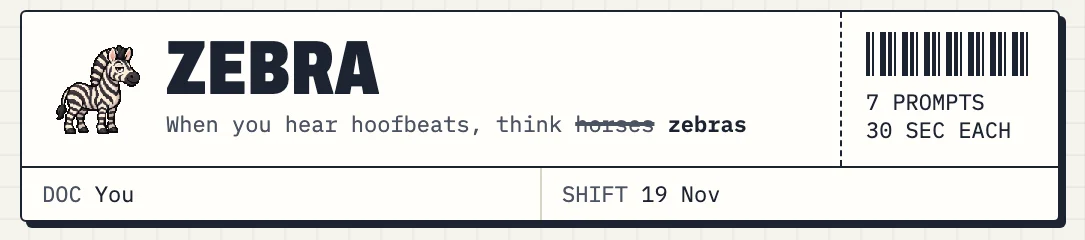
The header points to a medical proverb. Doctors are taught “when you hear hoofbeats, think horses, not zebras”: reach for the
common diagnosis first. The game’s tagline turns that around. Its header reads “When you hear hoofbeats, think horses zebras”, and the
rarer your correct answer, the more it scores.
Where the saying comes from
According to Wikipedia’s article on the term, the line goes back to Theodore Woodward, who taught at the University of Maryland School of Medicine in the late 1940s and told interns: “When you hear hoofbeats behind you, don’t expect to see a zebra.” The same article says the phrase became widely known in the 1960s and that “zebra” is American medical slang for an unexpected diagnosis.
The saying contrasts familiar explanations with unusual ones. Here it is background to the game’s wording, rather than a rule for making clinical decisions.
What a “medical zebra” is
From the proverb, “zebra” became slang for a rare or surprising diagnosis, the case that really was the exotic one. A related piece of slang is “fascinoma”, a fascinating but rare finding. Some patient communities have adopted the animal for themselves: people with Ehlers–Danlos syndromes call themselves medical zebras, and the zebra is the emblem used by groups such as The Ehlers-Danlos Support UK.
How the game uses the idea
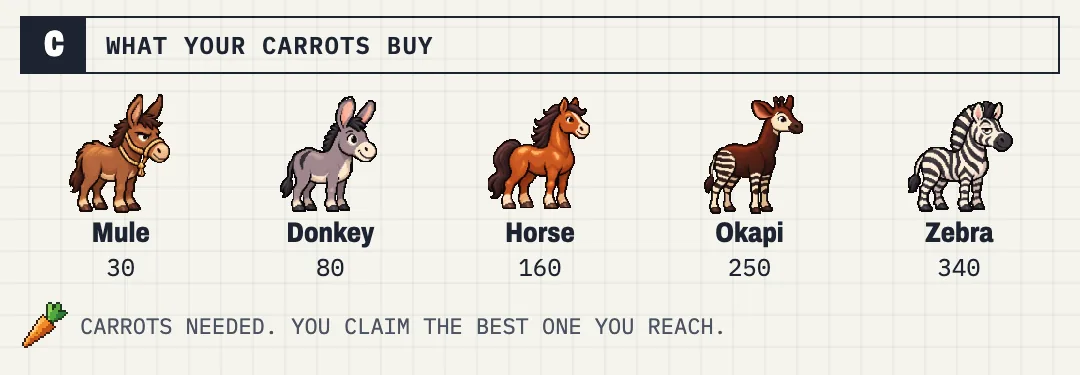
Zebra is a quiz, not a clinic, so the rare answer is not a mistake there; it is the goal. Accepted answers score according to editorial rarity tiers, with higher tiers earning more carrots. The prize ladder follows the same joke, from the ordinary to the striped:
- Mule at 30 carrots: “It's a mule. It's yours. Love it anyway.”
- Donkey at 80 carrots: “Honest work. Your SHO would be proud.”
- Horse at 160 carrots: “Solid. Exactly what the textbook told you to think.”
- Okapi at 250 carrots: “Most people have never heard of one. Much like your answers.”
- Zebra at 340 carrots: “You heard hoofbeats and thought zebras. Correctly.”
The okapi, one step below the zebra, is a fitting choice: it is a real striped-legged animal that most people have never seen, a rare answer in its own right. The scoring details are on the scoring page.
Other things called Zebra
The name is popular. Zebra Technologies makes scanners and printers, there is an iOS package manager called Zebra, a logic grid known as the Zebra Puzzle, and a separate party game at playzebra.app. A second daily medical game, ZebraDive, uses the same proverb; see Zebra vs ZebraDive. For the game itself, start on the home page.
Questions
What does “zebra” mean in medicine?
In medical slang a zebra is a rare or surprising diagnosis, chosen when a common explanation would have been more likely. The term comes from the saying “when you hear hoofbeats, think horses, not zebras”.
Who said “when you hear hoofbeats, think horses”?
It is usually credited to Theodore Woodward, a professor at the University of Maryland School of Medicine, in the late 1940s.
Why does the Zebra game reward rare answers?
It turns the proverb around. The header crosses out “horses” and writes “zebras”. In the game, accepted answers earn carrots according to editorial rarity tiers.
Sources
- playzebra.io home page (Today’s Shift, tiers, animals, archive strip) · checked 20 November 2026
- Wikipedia — Zebra (medicine) · checked 19 November 2026
- The Ehlers-Danlos Support UK · checked 19 November 2026
- playzebra.io FAQ (seven official questions) · checked 20 November 2026
Updated 19 November 2026